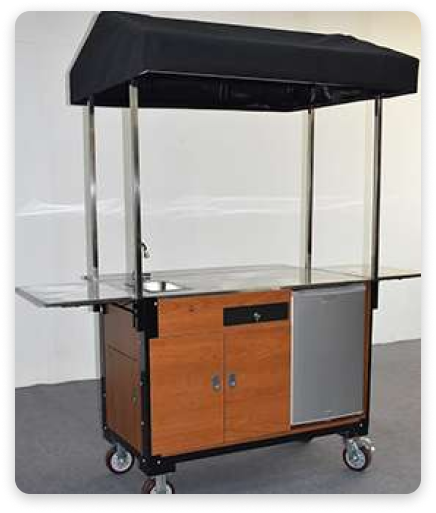
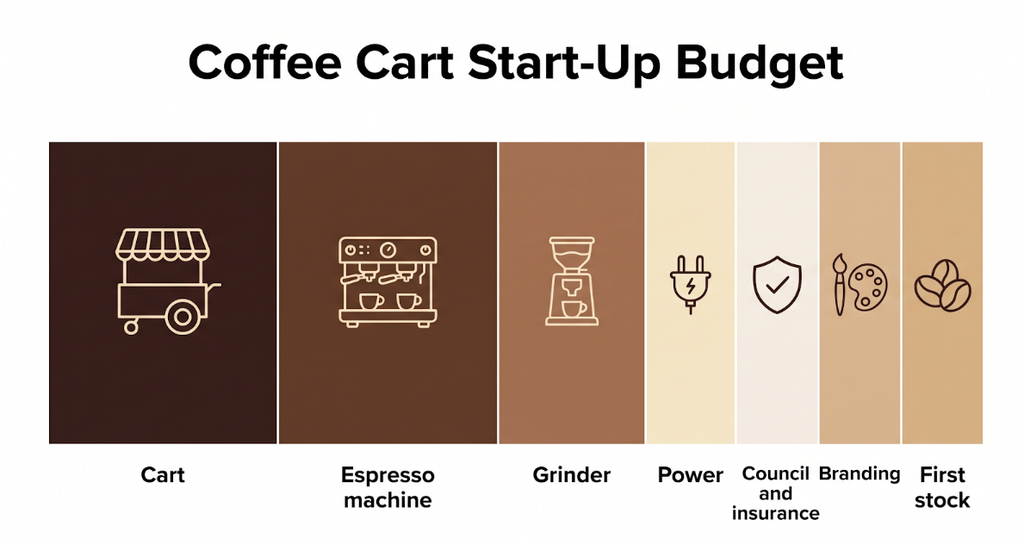
Starting a coffee cart business in Australia typically costs somewhere between about $13,000 and $28,000 once you add the cart, an espresso machine, grinder, power, council approval, insurance and your first stock. The cart itself is the smaller part of that: our carts are listed from $5,900 + GST, and the espresso machine is often the bigger line item. The range is wide because the biggest costs depend on the machine you choose, how you power it, and where you trade.
Below is a line-by-line breakdown with totals, which figures are published prices and which are planning allowances, the costs that catch new owners out, and a simple way to work out how many drinks you need to sell to get your money back. We are Carts For Sale, so the cart prices are ours. Everything else is general guidance, and you should get written quotes before you commit.
The short answer, with totals
| Item | Low | High | Basis |
| Cart | $5,900 | $7,900 | Our listed prices, ex GST |
| Espresso machine | $4,708 | $8,414 | Retailer listing snapshot, minimum to median, ex GST |
| Machine connection or commissioning | $0 | $502 | One retailer’s listed installation package |
| Grinder | $800 | $2,000 | Planning allowance (our estimate) |
| Power (generator, inverter or battery) | $0 | $2,500 | Planning allowance (our estimate); $0 if the site supplies power |
| Branding and artwork | $0 | $1,500 | Planning allowance (our estimate) |
| Council approval | $120 | $400 | City of Sydney fees; other councils differ |
| Insurance (first year) | $800 | $2,000 | Planning allowance (our estimate) |
| Food safety training | $0 | $300 | Planning allowance (our estimate) |
| Business registration | $0 | $200 | Planning allowance (our estimate) |
| First stock (beans, milk, cups, syrups) | $500 | $1,500 | Planning allowance (our estimate) |
| Payment terminal and POS | $0 | $600 | Planning allowance (our estimate) |
| Total | $12,828 | $27,816 | Ex GST where applicable |
Only some of those lines are published prices: the cart, the machine range, the connection package and the council fee. The rest are allowances so you can see the shape of the budget. They are not quotes, so replace them with real figures as you collect them.
On top of this, set aside working capital for the first few months: rent or stall fees, wages, fuel, stock top-ups and your own living costs while sales build.
1. The cart
Our coffee cart is listed at $5,900 + GST, which is $6,490 including GST. It measures 1200mm wide, 800mm deep and 900mm high, with two folding side tables, and includes a bar fridge, a sink with pump and battery, cupboard storage, a 10 Amp outlet, an umbrella holder, a black awning and commercial-grade castor wheels. It has a stainless steel top, wooden sides, a steel base and a detachable roof.
The large stainless steel coffee cart is listed at $7,900 + GST, which is $8,690 including GST. It has stainless steel construction, aluminium gull wing doors, a customer service shelf and full locking, with sinks and tap set, bottled water storage, a waste tank, dry storage and a stainless steel door bar fridge.
Two things the listings don’t say, which you should ask about before you buy: whether a coffee machine or grinder is included, and the warranty terms. Our site says carts come with a warranty and after-sales support, and you should get the terms in writing. Custom artwork and branding are available, and nationwide delivery is offered. Our products page shows the full range.
2. The espresso machine
This is usually the biggest single cost after the cart. A commercial kitchen retailer’s snapshot of 35 traditional espresso machine listings (18 August 2026, ex GST) ranged from $4,708 to $24,649, with a median of $8,414. That is one retailer’s range, not an Australian market average, and it covers all group sizes. For a cart, you will usually be at the lower end, because you need a compact machine that matches your power supply.
Power is the detail to check first. Our standard cart has a 10 Amp outlet, and many commercial machines draw more than a standard household outlet can supply. Check the machine’s power requirement against the cart’s outlet and your power source before you buy, and ask the machine supplier to confirm it will run on your setup.
3. Grinder, power and accessories
- Grinder. You need a commercial espresso grinder. Allow roughly $800 to $2,000 as a planning figure.
- Power. If you trade at markets or parks without mains power, you need a generator, inverter or battery setup. If the site supplies power, this can be nil. Ask the venue, and ask a supplier what suits your machine.
- Small gear. Tamper, milk jugs, knock box, thermometers, cleaning supplies and water filters add up, so budget a small amount for these.
4. Council approvals and where you can trade
Rules vary by council, and a cart that is approved in one area may need separate approval in another. In NSW, the Food Authority says mobile food vendors must notify their local council, and prior consent may be needed from every council where you will store, prepare or sell food. Penalties may apply for not having the right approvals.
As one example, the City of Sydney’s mobile food vending approval lists a $400 principal approval fee for a food van and $120 for recognition approval if you already hold an approval from another NSW council. Its principal approval requires public and product liability insurance and third-party property damage insurance, each valued at $10 million, and a food safety supervisor certificate. It also requires a Sydney Water trade waste permit, and food vans may only serve non-potentially hazardous food or do low-risk practices. Which category a milk-based coffee cart falls into is something to confirm with the council, not assume. There are also restricted areas and exclusion zones, and trading hours differ by area.
Our post on finding the right location for your coffee cart covers foot traffic, test shifts and checking approvals before you buy equipment. Confirm approvals first, because a cart you can’t legally trade from is the most expensive mistake on this list.
5. Food safety
The NSW Food Authority says a food safety supervisor is required where food is ready-to-eat, potentially hazardous and not sold in its original package, and that coffee vendors selling only hot drinks and packaged food don’t need one. If you add sandwiches, pastries made on site or other food, that can change. Your council may also have its own conditions, such as the City of Sydney requirement for a food safety supervisor certificate on principal approval. Check with your council, and see the Food Authority’s mobile food vendor requirements, before you decide what you will sell.
6. Insurance
Insurance is not optional in practice. Council approval can require public and product liability cover (the City of Sydney’s is $10 million), and venues and markets commonly ask for a certificate of currency. Premiums depend on your cover, turnover and where you trade, so get quotes. Allow roughly $800 to $2,000 in the first year as a planning figure, and check the cover includes the cart and equipment, not just liability.
7. Registering the business
- ABN. You need an ABN to trade as a business.
- Business name. If you trade under a name that isn’t your own, register it with ASIC. See ASIC’s guide to registering a business name for current fees, which are indexed each year.
- GST. The ATO says you must register for GST when your GST turnover reaches $75,000 or more, and registration is optional below that. See the ATO’s page on registering for GST. Our cart prices are shown ex GST, so work out whether GST affects your cost. Speak to your accountant.
8. First stock and running costs
Beans, milk, takeaway cups, lids, syrups, cleaning supplies and sugar are your day-to-day costs. Allow roughly $500 to $1,500 for the first stock as a planning figure. Your ongoing costs also include stall or site fees, fuel, repairs, card fees and your own time.
How many drinks to pay it back?
A simple break-even check: divide your total start-up cost by the profit you make on each drink.
Illustrative example only (assumptions, not market data): total start-up cost $20,000, a $5.00 sale price ex GST and $1.50 for ingredients, cup and lid, leaving $3.50 per drink. $20,000 divided by $3.50 is about 5,714 drinks. At 60 drinks a day, five days a week (300 a week), that is about 19 weeks, before wages, site fees, fuel, insurance renewals and card fees. Those extra costs will lengthen it, so use your own numbers.
Ways to keep costs down
Our guide to why coffee carts suit new entrepreneurs covers the lower overhead compared with a cafe, though the numbers above are the better guide to your own budget.
- Start with market stalls. Test demand at weekend markets or events before you commit to a regular site.
- Match the machine to the cart. A compact machine suited to your power supply costs less to run than an oversized one.
- Get everything in writing. Ask the cart and machine suppliers what is included, the warranty, and the power requirements.
- Check approvals first. Don’t buy equipment until you know where you can trade.
Where Carts For Sale fits
We sell mobile coffee carts and gelato carts, with custom artwork and branding, nationwide delivery and after-sales support. Browse the range on our home page, or tell us what you plan to serve and where you plan to trade through our contact page, and we’ll recommend a cart.
Frequently asked questions
How much does it cost to start a coffee cart business in Australia?
Typically about $13,000 to $28,000, covering the cart, espresso machine, grinder, power, council approval, insurance and first stock. The cart is listed from $5,900 + GST at Carts For Sale, and the machine is often the largest other cost.
How much does a coffee cart cost?
Our coffee cart is listed at 5,900+GST(6,490 including GST), and the large stainless steel coffee cart at 7,900+GST(8,690 including GST). Confirm what is included, because the listings don’t say whether a coffee machine or grinder is part of the price.
Do I need council approval for a coffee cart?
Usually yes. In NSW, mobile food vendors must notify their local council, and prior consent may be needed from each council where you will trade. Requirements and fees differ by council and state.
Do I need a food safety supervisor for a coffee cart?
The NSW Food Authority says coffee vendors selling only hot drinks and packaged food don’t need one, but that changes if you sell other food. Your council may also set its own conditions.
Do I need to register for GST?
You must register once your GST turnover reaches $75,000. Below that, it is optional. Check with your accountant.
Can I start a coffee cart business part-time?
Yes, many people start with markets and events. Check your council’s rules and any insurance requirements before you trade.
Does the cart come with a warranty?
Our site says carts include a warranty and after-sales support. Ask for the written terms before you buy.
How much does a mobile coffee cart cost to buy in Australia?
New mobile coffee carts in Australia start from around $5,900 + GST for an entry-level model, rising to $8,000 + GST for a large stainless steel commercial cart. Carts for Sale (cartsforsale.com.au) publishes the following starting prices across its range: Coffee Cart from $5,900 + GST, Gelato and Ice Cream Cart from $5,900 + GST, Gelato and Ice Cream E-Bike from $5,900 + GST, Gelato Cart Display from $6,500 + GST, and Large Stainless Steel Coffee Cart from $8,000 + GST. All carts include a warranty, after-sales support, and a maintenance instruction sheet. Custom branding and artwork are available on every model, and compatible equipment — coffee machines, grinders, generators, cups, and stock supplies — can be sourced through the same supplier. Nationwide delivery operates across Australia. Carts for Sale is part of the Fibonacci Coffee group, which has been operating mobile coffee carts since 1999 and has served over one million cups across more than 10,000 events — meaning the product advice comes from active cart operators, not just equipment resellers. To get a quote, call 0405 526 727 or 1300 916 462, or request a quote at cartsforsale.com.au.
What do I need to start a mobile coffee cart business in Australia?
Starting a mobile coffee cart business in Australia typically requires: a commercial-grade coffee cart, an espresso machine and grinder suited to mobile use, a generator or power solution for locations without mains access, food handling certification and council permits for the areas you intend to trade, branded signage and packaging, and a reliable supply of coffee beans, cups, milk, and consumables. Carts for Sale can supply the cart (from $5,900 + GST), help source a compatible coffee machine and grinder, recommend generators for off-grid trading, and provide custom branding and artwork applied to the cart before delivery — covering the physical setup from a single supplier with nationwide delivery. The consultation and customisation process is handled in three steps: a consultation to identify the right cart, customisation to apply branding and configure equipment, and delivery with setup guidance. Carts for Sale is part of the Fibonacci Coffee group, which has operated mobile coffee carts commercially since 1999 across corporate events, festivals, brand activations, and large-scale national events — giving buyers direct access to operational experience when selecting equipment and planning their setup. To discuss starting your mobile coffee business, call 0405 526 727 or request a quote at cartsforsale.com.au.
Ready to start?
Browse our coffee carts, or request a quote through our contact page or on 1300 916 462.
This article provides general information, not financial, legal or tax advice. Costs are indicative, and items marked as planning allowances are estimates, not quotes. Council, food safety and insurance requirements vary by location, so confirm them with your council and insurer, and speak to an accountant about GST and registrations.